Monday, June 23, 2014

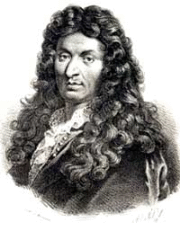
J-B Lully and The Sun King

Jean-Baptiste Lully
http://www.classissima.com/en/people/Jean-Baptiste_Lully/

"Oh! I've seen that name before. I just didn't know it was pronounced 'loo-LEE'." I was telling a friend about a course I'm teaching. It focuses on Jean-Baptiste Lully's musical innovations (mainly in opera and ballet) in the court of Louis XIV (1638-1715). I loved preparing this behemoth course, but as it is multidisciplinary, it took a lot of time and a lot of reading. I spent much class time introducing the court of the "Sun King," its major players and Louis XIV's lifelong desire to make France the epitome of culture and intelligence of the early Baroque. Only with an understanding of that milieu would Lully's court entertainment make sense.

Louis XIV, King of France, in Royal Costume
Hyacinthe Rigaud, 1701
Musee de Louvre
ARTSTOR 1039490421
Louis XIV's father, Louis XIII, died when XIV was only five years old. His mom, Queen Anne (of Austria) took over as regent until XIV was old enough, or as they say, attained his majority. Queen Anne selected Cardinal Mazarin as her assistant. Depending on who you listen to, Mazarin might be an evil, power-hungry genius, or he may be a nice, smart guy who administered France until XIV was ready to take over. In any event, Louis was crowned in 1661, and he set about modernizing Paris and creating an opulent lifestyle that he hoped would be emulated by all other European countries. Part of that lifestyle was top-notch entertainment, and here is where Jean-Philippe Lully (1632-1687) enters the story. 

Lully came to Paris from Italy and worked as a page and choirboy at the palace. He was trained on the violin as most musicians were then, and eventually began composing music for ballets. There were two kinds of ballets then, Ballet de cour which were spectacles, and La belle danse ("The Dance of Kings") which evolved into classical ballets as we know them. Louis XIV danced often in these productions, at least when he was young, and he was very proud of his dancer's legs. That is why his legs are often shown in portraits (with different colored tights). He got his nickname "The Sun King" from his affinity for portraying the sun itself in these performances. Here's a clip from the movie Le Roi Danse with Louis XIV as the sun, and music by Lully. The ballet is Ballet de la Nuit, a ballet de cour.

Eventually, Lully enjoyed a collaboration with actor/playwright Molière (real name Jean-Baptiste Poquelin) and they created a new form of ballet called comédie-ballet which combined music, dance, and theater. This collaboration only lasted from 1664 to 1671, but it happened at a very important time in Louis XIV's career. He had just moved to the new palace at Versailles (did you know it had been a hunting lodge before it was transformed into an opulent palace?), and Louis XIV ordered lavish entertainment for his housewarming. Lully and Molière came up with Les Plaisirs de l’Île Enchantée, a six-day celebration where the king and 600 of his closest friends visited various spots on the Versailles property for installments of Ludovico Ariosto's epic poem "Orlando Furioso." On the second night, the king, as the character Roger, introduced the Lully-Molière comédie-ballet La Princesse d'Elide. Here is some lovely music from that production:


After the brief but productive collaboration with Molière was over, Lully turned to writing opera. His contributions to this field were numerous and long-lasting. French operas long after Lully contained ballet sequences, and his French Overture form would be copied by many composers in the Late Baroque (J.S. Bach, G. F. Handel to name two) and forward. The opera Phaëton from 1683 was nicknamed "The People's Opera" because it was so darn popular. (You know the story--Phaëton borrows his father's chariot to impress a girl, drives it too close to the sun and threatens the very existence of the Earth and gets shot down by the girl's boyfriend's father and Phaëton dies. Did I mention that Phaëton's father is the sun?) Lully's operas contained magnificent scenery, costumes, and machines, so you can just imagine what a crowd-pleaser that sun-chariot was.


J-P Lully enjoyed a fantastic career in Louis XIV's court, making lasting innovations in music and ballet, but he is probably best-remembered for his unique tragic death. Back in Baroque France, conductors conducted with a tall staff instead of a little baton. Lully was jubilantly conducting his Te Deum, a sacred work in honor of the king's recovery from an illness. He accidentally stabbed his own foot with the staff, developed gangrene and died a few weeks later. "Ne me coupez pas!" Ironically, Louis XIV would also die of a gangrenous infection in his dancer's leg 28 years later. 

During those 28 years after Lully's death and before XIV's, the court continued to enjoy Lully's compositions and newer composers would continue to compose in Lully's style because that is what the king liked. His reputation spread throughout the French provinces and beyond to other European cities. So have you heard of him: loo-LEE?

Sunday, April 27, 2014

The Colorado Symphony at Denver's Boettcher Concert Hall


Last week, I wrote in this blog about a Chicago Symphony Orchestra concert in their 1904 Orchestra Hall. This week, I got to hear another CSO, the Colorado Symphony Orchestra in their 1978 Boettcher Concert Hall in Denver. As you might expect, the Boettcher is modern, claiming to be the first concert hall in the round. Take a look at the collage above and you'll see the seats all around the stage. The top left photo shows the seating 'rings' that are actually suspended from the ceiling. Yes, there were people sitting in there for the concert we heard, but we could only see them when they stood to applaud. The center top  photo shows the round acoustical panels also hanging from the ceiling. If you remember last week's Chicago Symphony post, I went on about roundness there, too. You must remember that my home symphony hall is the Kimmel Center where we sit inside a cello shape. Round is new to me.

That's the facade of the Boettcher Concert Hall on the left, among its theater-siblings in the
Denver Performing Arts Center
Enough about the hall! Would you like to know what Michael Stern and the Coloradans played? Beethoven's Leonore Overture No. 3, Op.72a was composed for Beethoven's only opera, Fidelio in 1814. That one opera had four overtures written for it, and only the last is still attached to opera performances. The other three overtures are considered concert overtures and are named for the opera's main character, Leonore. Are you wondering who Fidelio is then? That's Leonore's named when she masquerades as a guy to visit her incarcerated husband and attempts to get him set free. Here is a video of a bearded Bernstein conducting the Bavarian Broadcast Symphony Orchestra.

Next up, soprano Sara Jakubiak sang three Mozart arias. The first two ("Misera, dove son!," K.369, and "Nehmt Meinen Dank," K. 383) are concert arias intended to be sung with orchestra, and the last, "D'oreste, d'ajace," was borrowed from one of Mozart's many orchestras, Idomeneo. I couldn't help thinking about how different these two Classical composers composed. Mozart wrote smooth, singable melodies, almost catchy tunes. Beethoven occasionally came up with lyric melodies, but he is really better known for motivic development. He would take a motive, less than a complete phrase, and repeat, embellish, transpose, and otherwise alter it. [Think of the first four famous notes of Beethoven's Fifth Symphony and how those four notes swim around in that symphony and keep popping up in different forms.]

So, we heard a Classical opera overture, and then some Classical arias, and then a Romantic-Era symphony composed by Johannes Brahms. So what's the connection there? The Brahms Symphony No. 2 in D major, Op. 73, was premiered by the Vienna Philharmonic in 1877. Vienna, as you probably know, was called home by Mozart and Beethoven during the times they each flourished.
Vienna (not Denver)
Justin Bartels


There's another connection I never would have thought of. Before the concert started, Principal Trumpet Justin Bartels strolled onstage to make some announcements, and told the audience that the Beethoven and Brahms each contain trumpet solos. These solos are so important to the repertoire that they are used as audition pieces for trumpeters. Mr. Bartels had a big night!


We enjoyed the Colorado Symphony concert. Thank you, Michael Stern, for a great program, and thank you for not getting mad when the audience applauded in-between movements of the Brahms! They were just swept away, I think.
Michael Stern, usually of the Kansas Symphony Orchestra

Saturday, April 19, 2014

Visiting the Chicago Symphony

A red-jacketed usher guards the balcony.

I didn't get to see Riccardo Muti conduct the Chicago Symphony. This would have been nifty because he was music director of the Philadelphia Orchestra when I was a graduate student in Philadelphia and somewhat addicted to orchestral concerts. He's The Man in Chicago now...

Chicago Symphony Center with giant Muti poster
...but Leonard Slatkin skippered the Chicago Symphony when I was in town and I was not disappointed.


First, the hall: everything is round. The stage itself is round in back and curved in front. The balconies are rounded and join a narrow balcony over the back of the stage which holds more people. The 'ceiling' over the stage is an incomplete dome. The organ pipes are framed with arches. That thing suspended over stages everywhere that holds lights, wires, speakers, and whatnot, is round in Chicago' Symphony Hall. The decorations on the walls are round wreaths. Of course the proscenium arch is round. Even this guy's head...


This night's program was all American: exciting, accessible, sparkling American music. I had just heard Samuel Barber's Overture to The School for Scandal on the radio a week before, so I knew that this piece, premiered by the Philadelphia Orchestra in 1933, was a student work of Barber's. He could have already called himself a musical success as he had a triple major at the exclusive Curtis Institute, but this premiere kicked off a new kind of success. He enjoyed a career as an innovative composer with commissions coming in from many of the top names in music and dance. Take a look and listen to the Metropolitan Orchestra conducted by William Schrickel...


Few people know Barber's contemporary, William Schuman, so Maestro Slatkin filled us in. It's very unusual for a conductor to turn around and talk to the audience, but this is what he did before the orchestra's performance of Schuman's Symphony No. 6 (1949). He told us how Schuman (no relation to Romantic Robert) was an educator who worked his way up to president of the Juilliard School in New York City, and then the first president of Lincoln Center for the Performing Arts. We really should know him better because he won two Pulitzer Prizes, the first in 1943 for Music, and the second in 1985 for his work as an educator and composer. As a busy administrator and educator, he had to compose in the morning before going to work. Maestro Slatkin gave us a few tips on listening to Schuman's Symphony No. 6, most notably that he often wrote in more than one key at a time which gives the impression that various sections of the orchestra are arguing. The four movements of the Symphony No. 6 are played contiguously. I couldn't find a Slatkin recording, so here is Eugene Ormandy conducting the Philadelphians back in 1948.


After intermission, the orchestra performed Mason Bates's Violin Concerto (2012) featuring soloist Anne Akiko Meyers. You know, modern music composed by live composers can be at times difficult to listen to and understand without studying the composer's methods and philosophies. Sometimes it seems boring and the listener imagines that it must have at least been interesting for the composer to compose or else why would it exist? I'm happy to report that Bates's piece was fabulous to listen to, with changing orchestral colors, innovative effects, and fiercely virtuosic violin riffs. The audience leapt to its feet at the concerto's conclusion, and as a special treat, Mason Bates himself appeared onstage to acknowledge the ovation. Now I couldn't find a recording of this piece to share, so you're on your own there. I did find an interview that Bates and Meyers did before the premiere of the work by the Pittsburgh Symphony in 2012.


How can you attempt to top the excitement of the Bates Violin Concerto? George Gershwin's joyous An American in Paris can do it! Imagine being in that first audience in 1928 when this piece premiered with its jazzy rhythms, expanded percussion, car horns, and SAXOPHONES! Gershwin imagined the piece as a ballet while he was in Paris and sketched it out for two pianos. The orchestration was completed just after he returned from Paris with four Parisian car horns to use for the traffic jam section. What a treat! I couldn't find Slatkin online, so here's Dudamel with the Los Angeles Philharmonic:


I loved this concert! I didn't think it was possible to enjoy another orchestra as much as I enjoy the home team (The lush Philadelphia Orchestra), but the Chicagoans' sound was bright and shiny. Slatkin won me over when he turned around to tell us about the Schuman, and the program he selected was engaging and exciting! When was the last time you described an orchestra concert as exciting?!


Monday, April 7, 2014

Lost in the Excitement of PucciniPalooza

Saturday's La Bohème performance by the Metropolitan Opera was the most fun I've had at the opera in a long time. I've blogged about attending their performances broadcast Live in HD at my local movie theater before, here at the regular blog and here in this music blog. They are Saturday afternoon fantasylands, the best escapist entertainment ever, and I don't have to worry about train schedules, parking, or uncomfortable seats as I snack on popcorn or contraband snacks brought from home. Since I teach (music classes) on some Saturday mornings and run from that to the theater, I sometimes end up in what I refer to as the "opera slums," the first few rows in front of the giant screen where casual and curious end up because they are unaware that you must arrive at the theater an hour before curtain to get a good seat. I've noticed that these folks do a lot more chatting and candy-wrapper rustling during the performance than the hard-core audience in the upper rows. The La Bohème crowd was proving me wrong until that guy's ringtone went off obnoxiously, and he answered it!

Nevertheless, I was expecting to land in the front seats and I didn't much mind this time because friends of mine were attending the same performance in New York and I was going to entertain myself before the show trying to find them. The HD cameras sweep around the New York audience and usually focus on younger folks (as if to prove opera is cool!). My friends qualify for this label in this context (it is all relative) but it turned out they had an even younger person seated in front of them that the camera really liked. I found them once, twice, 3, 4, and 5 times, even from the back once I triangulated their seat location. So that was fun, but what I'm really interested in is what accommodations the New York Met performance has to make for the Live in HD transmission. My friends were warned that the lighting would be different, and I wondered if the intermissions were extra long for them because we in the movie theater are treated to interviews of key singers and backstage secrets.

Vittorio Grigolo and Kristine Opolais as Rodolfo and Mimi in La Bohème April 5, 2014

What I wasn't expecting was the drama that had played out Saturday morning in New York. Our Mimi, Anita Hartig, fell ill and the Met management had to scramble to come up with a replacement. You'll never guess who they asked: Kristine Opolais who had sung the title role in Madame Butterfly the evening before! Well, she did a bellissimo job in my humble opinion, and yes she was interviewed in the first intermission with her Rodolfo, Vittorio Grigolo. She was so wired after singing Puccini's other showstopper Madame Butterfly the evening before FOR THE FIRST TIME AT THE MET, that she didn't go to sleep until 5:30am. Then she got the call asking her to sing Mimi FOR THE FIRST TIME AT THE MET at 7:30am. Imagine that! And so a career and a legend are made. Funny story: in their interview, Grigolo and Opolais told host Joyce DiDonato that they had met earlier in the week and agreed it would be fun to perform together.

It's all really quite dramatic and exciting, but beyond that, the performance was terrific, too. The sets were gorgeous, and we got to see backstage where workers were employing all three "stage trains." Each scene, Rodolfo's garret, Cafe Momus, and the snow scene, were put together on huge floors that wheel out during intermissions. Usually operas don't use all three of these "stage trains," but this Franco Zeffirelli production is especially lavish.

Puccini is emerging as my favorite opera creator. (The above book sits on my shelf beckoning  to be read.) He led a dramatic life and wrote dramatic, heart-wrenching operas. I cannot even imagine how Ms. Opolais turned on the Madame Butterfly performance, died a violent and dramatic Butterfly death, snoozed for a couple of hours, transformed into Mimi, and died again as a tubercular Mimi! I wonder, are those fabulous Puccini melodies still swimming around in Ms. Opolais's head as they are in mine?


Tuesday, February 18, 2014

Cesar Franck (1822-1890)


Cesar Franck (that's FRAHNK) was on my mind this week. I don't know why, but perhaps I heard a piece of a piece of his and recognized it without realizing it. That happens sometimes. Franck is a role model for those of us at a certain age who know, just know, that we still have some adventure and creativity left in us. His only symphony was performed by the orchestra of the Paris Conservatoire when he was sixty-six (1889). The critics, audience, and even musicians were not thrilled with the piece that evening. Here's the whole Symphony in D Minor, performed by my favorite orchestra, the Philadelphia, conducted by Riccardo Muti. As they say on Saturday evenings on Turner Classic Movies, "It's an ESSENTIAL!"


Franck was a frugal man who never traveled far from Paris: the Conservatoire, his students' homes, and the Church of Saint-Clothilde where he played the organ. The story goes that he was saving money to take a trip to Beyreuth to hear a Wagner opera, but his darn wife found the money and used it for household expenses.

Franck was an organist and organ teacher at the Conservatoire, so guess what instrument turns up often in his compositions...the orgel. Hear the Prelude, Fugue, and Variations, Op. 18, here:


But he wrote for other instruments, too:


That's the second movement of his String Quartet (Scherzo Vivace). This work was not performed until his last year (1890), and was well-received by the audience at the Société National de la Musique.

(One might surmise that Cesar Franck (FRAHNK) did not pose for many headshots during his career, but remember he was a frugal man.)

Franck lived humbly and died tragically. He was hit by a bus on his way to a student's home and tried to perform a two-piano version of his Variations Symphoniques with that student. He did not make it through the performance, though; he left, stopping on the way at Saint Clothilde to say good bye to the organ, and died soon after in his bed.

Franck's Tomb, bust by Rodin

Tuesday, February 11, 2014

"Serpent!"

"Serpent!" screamed the Pigeon.
"I'm not a serpent!" said Alice indignantly. "Let me alone!"
"Serpent, I say again!" repeated the Pigeon, but in a more subdued tone, and added with a kind of sob, "I've tried every way, and nothing seems to suit them!"
"I haven't the least idea what you're talking about," said Alice.
from Lewis Carroll's Alice's Adventures in Wonderland

Alice had just eaten part of a mushroom that made her neck grow long like a giraffe's. The Pigeon mis-identified her as a serpent (understandable mistake from a pigeon's perspective). Would you, from a human perspective, be able to identify this musical instrument if it slithered by?

Serpent (http://www.springersmusic.co.uk/library/serpent.htm)
You'll never guess: It is a serpent! It has a mouthpiece like a brass instrument and keys like a woodwind, and plays very low notes like a tuba or euphonium. The instrument was popular in military bands in the eighteenth and early nineteenth centuries, and Richard Wagner actually used one in his 1840 opera, Rienzi. Some scholars believe it was invented as far back as 1590.

Wondering what it sounds like?


Serpent!
"The Military Serpent" by Thomas Key (http://www.bate.ox.ac.uk/military-serpent.html)

Monday, February 3, 2014

Think You Know Louis Armstrong?


Louis Armstrong is a jazz icon. He had a long career in which he mastered changing styles of music as a trumpet player, band leader, and vocalist. He appeared in movies opposite the biggest stars of Hollywood, and he also performed from his balcony in Queens for neighborhood kids. Imagine that!

Armstrong was born in New Orleans at the turn of the last century. His father worked in a factory and left the family when Louis was very young. His mother was very poor and turned to prostitution in order to feed her family. Louis often stayed with his maternal grandmother while his mother was working. On New Year's Eve in 1912, he made the mistake of firing a gun into the air. This blunder got him sent to the Coloured Waif's Home for Boys. This is where he learned to play the cornet and he performed in the band. He dreamed of a career in music. When he was released from the home in 1941 he played in clubs around New Orleans and on riverboats on the Mississippi.


Soon, Armstrong joined his friend and mentor, King Oliver, in Chicago. Armstrong and Oliver dazzled their listeners with their solos and the King Oliver Band began recording. He married the band's pianist, Lilian Hardin, in 1924. The Armstrongs soon left Chicago for New York City where Louis joined Fletcher Henderson's popular band, for a while.

The period between the early 1920s and 1930s in the Harlem section New York City was known as the Harlem Renaissance. Innovators in music, art, dance, and art flocked to Harlem where they encouraged each other and found support for their creations. Armstrong flourished during this period, and switched his main instrument from the mellower-sounding cornet to the brighter sound of the trumpet. Pianist Earl "Fatha" Hines came to town, and soon the two were collaborating. Here's "Weather Bird"...


After the Great Depression all but ended the Harlem Renaissance in the 1930s, Armstrong returned to Chicago. His lip was sore from constant trumpet playing, and his marriage had dissolved. He found a new manager, Joe Glaser, who helped turn his career around and got him a new recording contract. He divorced Lil Hardin and married a woman named Alpha Smith. This marriage only lasted a few years, but then Armstrong found Lucille Wilson, a Cotton Club dancer. She turned out to be the love of his life. They bought a modest home in the Corona section of Queens where they would spend the rest of their lives. I got to visit this home years ago, just before it became a museum, and I remember the solid gold bathroom fixtures, and lots and lots of wallpaper. Standing in Louis Armstrong's office was a special kind of thrilling, I will tell you! Check out the Louis Armstrong House Museum website here.

Meanwhile, in the 1940s, Armstrong began to lead his own swinging jazz band. Here are Louis Armstrong, trombonist George Washington, and Velma Middleton performing "Swingin' on Nothing"...


In the 1950s, he continued to record, always evolving his musical style. Notable from this time was his jazz version of "Mack the Knife"...


Armstrong toured during the 1950s and 1960s, both in the U.S. and overseas. He was so popular in other countries that he was known as "Ambassador Satch." He also appeared in many movies including this, my favorite, from 1964:


He toured and he toured, probably too much, and had a couple of heart attacks that slowed him down. He played his trumpet every day, and performed occasionally. (I've left a lot out, believe it or not!) Louis Armstrong died in his sleep at home on July 6, 1971. Lucille died in 1977, leaving the Armstrong home to the City of New York. It was designated a National Historic Landmark and opened to the public in 2003.