Showing posts with label opera. Show all posts

Monday, October 6, 2014

The Barber of Seville, a Guest Post by Lester M Choodle

Your author, Lester M Choodle, waiting for the train to Philadelphia

My name is Lester M. Choodle and I am guest blogging for Margaret. My credentials: I sit on a perch in Margaret's house and as such I view an inordinate amount of operas, independent films, Law & Order episodes, and 1970s sitcom reruns on SD TV. I also get to hear music of all genres. I could file a report on the latest Bruce Springsteen record as easily as this blogpost on Rossini.

You may be wondering why I am writing the blog when she is sitting right beside me for the entire excursion. It seems that Margaret publicly stated this week that Rossini Operas Buffo are not her favorites. "I like drama," she said. I (Lester) am here as an impartial observer so that you, Margaret's readers, can be assured an impartial report on this opera production.

We took the train to Philadelphia for this matinee performance.


Here I am on the train with my ticket:


We attended the pre-performance talk at the Academy of Music where we got to sit in the posh seats close to the stage to hear Composer-in-Residence Lembit Beecher filled us in on this opera's history. Evidently, the first performance of The Barber of Seville was a catastrophe. A cat actually ran onstage, twice, distracting the singers and the audience. The tenor singing the Count Almaviva part sang his favorite Spanish song (not from the opera) in the first act, accompanied by his own untuned guitar. The second performance was much smoother, no animals ran onstage, and the opera has been a hit ever since. This setting of this performance, directed by Michael Shell, was updated to somewhere in the late twentieth century, the technicolor costumes were extraordinary, and the singing actors were given opportunities to ham-up their comic performances with exaggerated dance moves. Shell claims the movies of Pedro Almodóvar served as inspiration.

After the talk, we made our way up to the highest balcony called the Amphitheater for the performance. Where else would an owl perch for a performance? Here I am perched on the high wooden back of the seat in front checking out the stage:


Here I am back in my red velvet seat with my program and opera glasses:


But enough about me...This opera was probably familiar to most people in the audience, possibly from Bugs Bunny or Alfalfa on the Little Rascals, but we were instructed by Michael Shell's Director's Notes in the program to watch and listen as if this is the first time. This was not difficult since the sets and jewel-toned costumes were updated to the late twentieth century. Close your eyes and it is 1816. Open them and it is Technicolor 1970s or thereabouts. Don Basilio, Rosina's music teacher, performs an interesting Elvis impersonation.


Do you remember the plot? Lovely Rosina is the ward of Dr. Bartolo, and he falls in love with her. She falls in love with dashing Count Almaviva who is disguised as "Lindoro" so that he can assess whether Rosina is in love with him or his money. Figaro, the barber and jack-of-all-trades, ultimately helps the two young people get together by distracting Dr. Bartolo. Almaviva gets the girl, but Bartolo keeps her dowry, so everyone is happy.

One of the best scenes of this production was Dr. Bartolo's nightmare. (This scene replaces the traditional thunderstorm.) Bartolo was obsessed by roosters, and about seven of them, human-sized, invaded his bedroom and danced around. Roosters! Dancing! Terrifying! Colorful!

Margaret asked me which character I would like to perform if I were a singer/dancer/actor. She suggested "Figaro because he gets to wear that great coat with the eyes on it?"
"Who"
"Figaro."
"Who"
"FIGARO!"
"Who"
"FIG--oh yeah, you're an owl." ['Who?' in Owlspeak means 'yeah.']

Here's a different Figaro with a different coat singing "Largo al Factotum," one of the most popular arias of this opera. It's a patter aria which means it has fast-moving text that has a tendency to get stuck in your head. (Don't say I didn't warn you!) This is one of the aspects of Opera Buffo that grates on Margaret's nerves and gave me the opportunity to guest-post on this one.


Margaret realizes that this is an important step in the evolution of opera and that Rossini was a true opera innovator. In fact, The Barber of Seville is one of the milestones of opera history that she discusses in her course, The Passion of Opera. I'll close this post with a few slides from her course showing Gioacchino Rossini, the Teatro Argentina in Rome where The Barber of Seville premiered, and two images of Rosina.


Monday, June 23, 2014

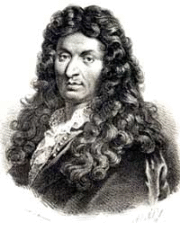
J-B Lully and The Sun King

Jean-Baptiste Lully
http://www.classissima.com/en/people/Jean-Baptiste_Lully/

"Oh! I've seen that name before. I just didn't know it was pronounced 'loo-LEE'." I was telling a friend about a course I'm teaching. It focuses on Jean-Baptiste Lully's musical innovations (mainly in opera and ballet) in the court of Louis XIV (1638-1715). I loved preparing this behemoth course, but as it is multidisciplinary, it took a lot of time and a lot of reading. I spent much class time introducing the court of the "Sun King," its major players and Louis XIV's lifelong desire to make France the epitome of culture and intelligence of the early Baroque. Only with an understanding of that milieu would Lully's court entertainment make sense.

Louis XIV, King of France, in Royal Costume
Hyacinthe Rigaud, 1701
Musee de Louvre
ARTSTOR 1039490421
Louis XIV's father, Louis XIII, died when XIV was only five years old. His mom, Queen Anne (of Austria) took over as regent until XIV was old enough, or as they say, attained his majority. Queen Anne selected Cardinal Mazarin as her assistant. Depending on who you listen to, Mazarin might be an evil, power-hungry genius, or he may be a nice, smart guy who administered France until XIV was ready to take over. In any event, Louis was crowned in 1661, and he set about modernizing Paris and creating an opulent lifestyle that he hoped would be emulated by all other European countries. Part of that lifestyle was top-notch entertainment, and here is where Jean-Philippe Lully (1632-1687) enters the story. 

Lully came to Paris from Italy and worked as a page and choirboy at the palace. He was trained on the violin as most musicians were then, and eventually began composing music for ballets. There were two kinds of ballets then, Ballet de cour which were spectacles, and La belle danse ("The Dance of Kings") which evolved into classical ballets as we know them. Louis XIV danced often in these productions, at least when he was young, and he was very proud of his dancer's legs. That is why his legs are often shown in portraits (with different colored tights). He got his nickname "The Sun King" from his affinity for portraying the sun itself in these performances. Here's a clip from the movie Le Roi Danse with Louis XIV as the sun, and music by Lully. The ballet is Ballet de la Nuit, a ballet de cour.

Eventually, Lully enjoyed a collaboration with actor/playwright Molière (real name Jean-Baptiste Poquelin) and they created a new form of ballet called comédie-ballet which combined music, dance, and theater. This collaboration only lasted from 1664 to 1671, but it happened at a very important time in Louis XIV's career. He had just moved to the new palace at Versailles (did you know it had been a hunting lodge before it was transformed into an opulent palace?), and Louis XIV ordered lavish entertainment for his housewarming. Lully and Molière came up with Les Plaisirs de l’Île Enchantée, a six-day celebration where the king and 600 of his closest friends visited various spots on the Versailles property for installments of Ludovico Ariosto's epic poem "Orlando Furioso." On the second night, the king, as the character Roger, introduced the Lully-Molière comédie-ballet La Princesse d'Elide. Here is some lovely music from that production:


After the brief but productive collaboration with Molière was over, Lully turned to writing opera. His contributions to this field were numerous and long-lasting. French operas long after Lully contained ballet sequences, and his French Overture form would be copied by many composers in the Late Baroque (J.S. Bach, G. F. Handel to name two) and forward. The opera Phaëton from 1683 was nicknamed "The People's Opera" because it was so darn popular. (You know the story--Phaëton borrows his father's chariot to impress a girl, drives it too close to the sun and threatens the very existence of the Earth and gets shot down by the girl's boyfriend's father and Phaëton dies. Did I mention that Phaëton's father is the sun?) Lully's operas contained magnificent scenery, costumes, and machines, so you can just imagine what a crowd-pleaser that sun-chariot was.


J-P Lully enjoyed a fantastic career in Louis XIV's court, making lasting innovations in music and ballet, but he is probably best-remembered for his unique tragic death. Back in Baroque France, conductors conducted with a tall staff instead of a little baton. Lully was jubilantly conducting his Te Deum, a sacred work in honor of the king's recovery from an illness. He accidentally stabbed his own foot with the staff, developed gangrene and died a few weeks later. "Ne me coupez pas!" Ironically, Louis XIV would also die of a gangrenous infection in his dancer's leg 28 years later. 

During those 28 years after Lully's death and before XIV's, the court continued to enjoy Lully's compositions and newer composers would continue to compose in Lully's style because that is what the king liked. His reputation spread throughout the French provinces and beyond to other European cities. So have you heard of him: loo-LEE?

Monday, November 25, 2013

Monteverdi's Orfeo and Really Early Opera

Claudio Monteverdi (1567-1643)
So here in a nutshell is how opera started: first, a couple of composers from Florence named Peri and Caccini each wrote musical versions of the Orpheus and Euridice story. In order to imitate the Greek drama they were familiar with, they used a lot of recitative. This fast-talking sing-songy speech helps propel the action and the excitement. These operas did not survive, so we only know that little bit from writers who were there for the performances.

Then there was Monteverdi, who also wrote an opera on the Orpheus and Euridice theme. His opera is now commonly known as Orfeo and was first performed in 1607. The opera was written for Duke Vincenzo Gonzaga, who lived in Mantua. Monteverdi wrote the music of the opera, but a man named Alessandro Striggio wrote the words. Striggio was an aristocrat and part of an academy of gentlemen dedicated to the arts called the Accademia degli Invaghiti ('academy of the lovestruck' or 'people fascinated by something'). Monteverdi was the court composer in the Gonzaga court, and as such was a mere employee, not eligible for the Accademia!

The Accademia was behind the production of Orfeo, and the Duke's brother Prince Francesco was its chief organizer. There was one performance for the gentlemen of the court, one for the ladies, and then...it was not performed again until the twentieth century. The score, however was published. This was unusual for the time, and lucky for us because it acts as an artifact.

Monteverdi was an innovator to early seventeenth-century ears:
  • he used a variety of instruments in the orchestra to add color to the storytelling
  • he used ritornellos, or repeating sections of music, throughout the opera to give the work unity
  • he placed an overture at the beginning of the opera, but he called it the opening toccata.

Attendees of this opera would have been educated and they would have already known the Orpheus story. I'll catch up my 21st-century readers: Orpheus and Euridice got married, and she was bitten by a snake during their wedding reception and died. Orpheus went after her in the underworld. He used his lyre (a small harp) to lull the guardians. Euridice was allowed to go with Orpheus, but the deal was he wasn't allowed to turn around and look at her until they got all the way home. Orpheus was okay with this, and they started home. Euridice did not know about the agreement and wondered why Orpheus would not turn around or even answer her. She figured he no longer loved her and said so--he turned around--and she slipped back into the darkness of Hades. In the Monteverdi/Striggio version of  the story, Apollo intervenes and takes Orpheus to heaven. (This was a Christian influence.)

After Monteverdi, the center of opera innovation moved around Italy for a bit, and then settled in Vienna where Christoph Willibald Gluck wrote an opera blockbuster called...Orfeo ed Euridice...


Monday, September 30, 2013

Nabucco in Philadelphia

The Academy of Music Chandelier
Opera Philadelphia usually surprises me with some kind of operatic innovation, and the current production of Nabucco is no exception. First of all, I was surprised by a phone call and email reminding me that "my performance" was on Sunday at 2:30, and if I was interested, there would be a pre-opera talk by Michael Bolton at 1:30. (This would be the Vice President of Community Programs for Opera Philadelphia, not Michael Bolton the song stylist. I just want to make that clear.) I like those, so I made sure to attend, and I learned about Nabucco and this production in particular. As informative and delightful as the talk was, it was not the innovation to which I was referring.


The post by my seat.
You have to understand a little about the history of Giuseppe Verdi and his opera Nabucco to understand how Opera Philadelphia made this production a story within a story. (That's the innovative part.) At the time that this opera premiered at La Scala in Milan, that city was being occupied by the Austrians. The Italians created some great art that represented how they felt, just not obviously. The Assyrians in this opera represented the Austrians (they sound similar), and the Jewish people represented the repressed Italians. Verdi himself came to be a symbol of the Risorgimento, the Italian movement to unify Italian cities into one country with Victor Emanuel as king. Word has it ('word' in my music history books) that Verdi and his collaborators did not necessarily want to be a symbol, but since he wanted a unified Italy, too, he didn't fight it. The battle cry of the movement became Viva VERDI! The letters of Verdi's name stood for Vittorio Emanuele, RDItalia (Victor Emanuel, King of Italy).

So Nabucco was performed in Milan during this Austrian occupation, and an emotional time was had by all. One of the choral numbers in the opera even became the unofficial Italian national anthem. This Philadelphia performance capitalized on this by staging a large (meaning lots of singers and other costumed people on the stage) production of this soon-to-be anthem. This included 19th-century costumed stage hands and opera house personnel singing along with the singers, and large pieces of patched-together (as oppressed people would do) pieces of red, white, and green fabric held to form the Italian flag. We in the audience had already made the transformation to 1842 occupied Milan because of the presence of stern Austrian guards at the beginning, during intermissions, and eventually at the end. We also saw some fancy high-class Austrians in costume enjoying the festivities on stage and some 19th-century stagehands. (I can't tell you everything in case you go to see this production in Philadelphia, Washington, or Minnesota.)


The Academy of Music in Philadelphia, opened in 1857 (fifteen years after Nabucco's Milan premiere)

So that's a lot of story and I haven't even summarized the plot of the opera yet. Nabucco (Nebuchadnezzar in English) is the king of the Babylonians (also referred to as Assyrians in the opera), and he is driving the Jews from their homeland, but not without torturing and killing men, women, and children. The story is from the Bible, but of course on the opera stage Nabucco goes mad and suffers a dramatic collapse. One of his daughters grabs the throne while it is still warm and in order to stay seated there hides evidence recently discovered that proves she may not be who she thinks she is . Nabucco's other daughter gets reunited with that special soldier. One of the highlights of any Nabucco production is the performance of "Va pensiero" ("Fly, thought, on wings of gold") which is also known as the "Chorus of the Hebrew Slaves." It has come to be the unofficial national anthem of Italy. Here's Riccardo Muti conducting this chorus in Rome, 2011:


Monday, September 16, 2013

Opera Appreciation for the Diva-phobic

Some of my opera gear
I know how a lot of otherwise open-minded people feel. They are, for some reason, intimidated by opera. I can guess why; opera has been portrayed in the media for decades as elitist and esoteric. True, it's difficult to have a great appreciation for an opera production if you show up at the opera house unprepared, or if you catch some fancy singing on the radio by chance on a Saturday afternoon. But aren't you curious? Opera has been called the most sublime art form, the very pinnacle of artistic expression. It is also a vibrant, living art form, with composers composing new operas and companies offering innovative productions of the familiar repertoire

I recently taught a three-week course in opera appreciation, and most of the students were curious but tentative when they showed up for the first meeting. "I'm not musical." "I don't understand opera." "Opera is beyond me." By the end of the last class, they were wishing the course went longer--they were thirsty for arias and costumes, Puccini and Mozart. What about you? Would you like some tips for getting the most from an opera experience? I thought so, and now is the perfect time as you will see momentarily.

Otello
  1. If you haven't already, please read my earlier post on this blog about opera. Here I explain some of the vocabulary that you might encounter and I've posted some fun videos there, too: What Do We Talk About When We Talk About Opera?
  2. Get your hands on a good DVD of an opera. Check Netflix, but also check your public library. I recommend Carmen (starring Julia Migenes-Johnson) or Otello (starring Placido Domingo) as good gateway operas because each is staged like a movie but with top-notch performers usually found in opera houses. Or, look for one of the Puccini favorites because you'll recognize some of the tunes. You can find these on Amazon.com, too, but I'm trying to make this an inexpensive financial commitment (just in case you get hooked).
  3. While you are in the library (or Amazon), look for a book of opera synopses. I recently borrowed M. Owen Lee's The Operagoer's Guide: One Hundred Stories and Commentaries (Amadeus, 2003) and I didn't want to give it back. Lee's writing is modern and insightful, and it's hard to believe that his day job involves holy water, incense, and confessionals. Father Lee's book is still in print last time I checked. Fans of used bookstores can probably find vintage anthologies of opera stories. I have a 1947 edition of Milton Cross' Complete Stories of the Great Operas (Doubleday) which isn't exactly 'complete' anymore, as many operas have entered the repertoire since 1947.
  4. Find your DVD opera story in your book and read it, and then watch your DVD. Make sure to go into the settings and select English subtitles, even if your opera happens to be in English or even if you can claim fluency in your opera's language. It's hard to decipher sung words sometimes, so remove that barrier before you get started.
  5. Remove ambient distractions and enjoy the opera!
 Carmen

 6. If you enjoyed your DVD opera, take the next step. Consider attending a Metropolitan Opera Live in HD broadcast at a local movie theater. You can find the latest schedule and your closest participating movie theater here: http://www.metoperafamily.org/metopera/liveinhd/LiveinHD.aspx
The first of the season is coming up on October 4 (this is why this post is timely): Tchaikovsky's Eugene Onegin (I can't wait--I've never seen it.) These broadcasts cost about twice what a regular movie costs, but you get to see the opera live as it is performed at the Met in New York, AND, you'll be treated to interviews of singers and other opera folk during the intermissions. These events are wildly popular in my town, so much so that I have to plan on being in my seat a full hour before the curtain goes up. Latecomers get the seats right in front of the screen, which isn't as dismal a fate as they would be for the latest action film. Bring a tote bag with some reading for the breaks (the interviews and backstage tours don't last the whole intermission), some discreet treats if you are not wild about movie snacks, and a light sweater, and you are ready to enjoy a lavish operatic treat. The trailer below highlights what is coming up this season. (No, they don't pay me to promote these!)

Met

7. Finally, locate an opera company in your town and get yourself some tickets. Most likely, you will be handed a program upon arrival with a synopsis and list of characters, but you will have already read a synopsis in your book. There will be supertitles above the stage, or in some cases on the seat in front of you. Do you have opera glasses or binoculars, or can you borrow some? Bring them. Do you have a cough? Unwrap your lozenges before the start of the performance. Do you have a fancy gown and a velvet opera cape? You can probably leave them home unless you are seated  in a super-fancy box with dignitaries. I guarantee this experience will be extraordinary.

Monday, July 22, 2013

What DO we talk about when we talk about opera?

I didn’t always love opera. As a young college music student I dutifully studied Bizet’s Carmen and Berg’s Wozzeck. I attended opera performances with interest, but mainly because I felt I was supposed to: Wagner’s Götterdämmerung, Mussorgsky’s Boris Gudenov, and Puccini’s La Bohème. I nod knowingly when movie characters go to the opera, my all-time favorite being Nicolas Cage and Cher in “Moonstruck.”


Then something unexpected happened. As an older person attending the Metropolitan Opera’s Live in HD broadcasts at my local theater, I fell in love. My eyes were opened to a world full of beauty, charm, adventure, and melody. A renowned opera singer hosts each broadcast, interviewing singers as they step off the stage. They give the viewer fascinating behind-the-scenes peeks at scenery costumes, stage food preparation, and animal trainers. As a more mature person I bring my life’s baggage to a performance. I can relate to the characters’ pain, joy, and passion. It is sublime experience aurally, visually, and emotionally.

What do we talk about when we talk about opera? 

Here’s what:

·   Composer: Who wrote the music? Did he or she write other kinds of music, too?


·   Arias, Recitatives, and Interludes: Is there any famous music that you will recognize or that the opera is known for, like “Musetta’s Waltz” from La Bohème?


·    Story/Libretto: What is the story and where did it come from? Is it from mythology, the Bible, history, literature, or a modern story? What motivates the characters? Look online, in a bookstore, or in your library for a libretto or synopsis. Reading up on the story before attending the performance will enhance your enjoyment. Find Met summaries here: http://www.metoperafamily.org/metopera/history/stories/.


·    Librettist: Who wrote the words? Did they partner often with the composer? Did they get along? Mozart had two main librettists, Lorenzo da Ponte who he did not get along with, and Emanuel Schikeneder who was his friend and favorite collaborator.


·    First Performance: Where and under what circumstances was the opera first performed? Monteverdi’s L’Orfeo was performed for an Italian count at a private affair and not again until the twentieth century.


·    Contemporary Singers: Who is singing? I’ve never been a baseball fan, but I find myself wishing for baseball-style cards of opera singers telling me their specialties and previous roles.


·    Contemporary Productions: Sometimes musical theater and movie directors try their hand at opera and bring a new perspective. Sometimes more traditional directors have control. What is unique about any production?


·    Scenery and Costumes: Are they traditional, set in the time that the composer and librettist intended? Are they set in a different time period like the Met’s Rigoletto in Las Vegas? Are the costumes creative in some way like Julie Taymor’s irresistible puppet costumes for the Met’s production of The Magic Flute?


Grab a synopsis or a libretto and go experience an opera performance at an opera house, auditorium, or movie theater. Then, tell me what you think.