Showing posts with label Duke Ellington. Show all posts

Monday, March 20, 2017

The Harlem Renaissance Lecture


A few weeks ago, I delivered a lecture on the Harlem Renaissance as part of the Speakers' Series at Bucks County Community College's Zlock Performing Arts Center. The talk went well from my perspective, and most of the feedback I got was positive. Some feedback was VERY positive. I thought readers might like to know how this came about and what I was thinking during the experience. If you are not interested in that, then just skim through the text to the videos!

Before I walked on stage, I was feeling that my material was old and tired and the audience was not going to be much interested. I have taught a three-week course on the music, art, literature and dance many times (six? five?) at various retirement villages and adult schools in the area, so the material was very familiar to me. I've been interviewed about the topic and asked to guest-lecture on parts for literature courses. Even though I boiled down the six hours of course material to approximately ninety of the best minutes for the lecture, I thought it was stale. I tell my Effective Speaking students: "Remember WIIFM!" This means, always imagine that the people in your audience are asking "What's in it for me?" or "Why should I bother paying attention to you?" I've always used this tip when preparing classes or lectures and it works. I guess this is my version of performance anxiety: "My lectue just isn't fresh and exciting enough! :-("

I walked over to the new podium still thinking my material is stale, and was surprised to see that the house lights were way down and I could identify no faces! This might have freaked me out except that many years ago I had this same sensation when I walked out on stage with my high school jazz band. We played to the dark. My mother was out there, I knew, but I couldn't see her. I could hear the audience's applause for solos and after our charts were over. I quickly got used to the dark auditorium just as I did at the Harlem Renaissance lecture. It's a weird sensation, but a memorable one! I'm just talking to the dark...

 I used another Effective Speaking trick when I started the lecture: the Attention Getter. This could be an interesting "hook" sentence, a poem, a joke, or it could be an attention-getting video like this...
That's Whitey's Lindy Hoppers from a movie called Hellzapoppin' and it did get the audience's attention! I played it immediately after a quick hello, and I could hear their reactions!

After a few minutes, I stopped thinking my material was stale. The audience seemed to be enjoying it, and of course it was new to them! What was I thinking?! It wasn't stale! I talked about the art of the Harlem Renaissance and the Harmon Medal which was awarded to many of the best artists.
William H. Johnson's "Jitterbugs"--I got to see this up close at the Smithsonian American Art Museum less than a week before the lecture!
The audience coaxed me on, letting me know my lecture wasn't boring at all. It's strange how the time flies by while I'm focused on speaking. Suddenly it was time to advance the Prezi visual aid, and I knew that the video to pop up next was my favorite, the Nicholas Brothers' famous dance in the movie Stormy Weather called "Jumpin' Jive." This is a two-fer: it shows Cab Calloway, one of the two famous big band leaders at the Cotton Club (the other being Duke Eliington), and the fabulous Nicholas Brothers. It's a favorite whenever I teach this course, and I'm always excited to see the class's reactions. In this case I only heard gasps and laughter and ultimately applause:


I show another two-fer video which shows Duke Ellington and his band and the one singer Duke admired over all others, Ivy Anderson.


There's music throughout this presentation, but I move on to literature somewhere after the halfway mark. My favorite video in this segment is from the 1950s, but it shows Harlem Renaissance writer/poet Langston Hughes reading his own poem, "The Weary Blues." Even though it's more recent, I like to show it because it's the poet's own and it demonstrates so well the rhythm and syncopation so characteristic of Blues Poetry.


Did you catch it? This video also shows a white jazz band accompanying Hughes's reading. That would have never happened in 1920s Harlem, but in 1950s Canada where this was taped we've evolved some. I like pointing that out to students.

I could go on and on with these videos, but then I'd be showing you my whole lecture! I can't do that--I might have to deliver it again and I want to be sure it isn't stale. I do want to show you my ending, though. I always try to end on a happy note, and for this lecture, just like the course it came out of, I show a video of Adelaide Hall.


She was a singer during the Harlem Renaissance and got her big break when another singer died before she could take a part written for her by Jimmy McHugh and Dorothy Fields in the Broadway review Blackbirds of 1928. Adelaide Hall filled in and went on to have a great career in the Harlem Renaissance and for many years after. I found a video of her singing in a small club in 1989 and this clip just makes me feel good. She was 87 at the time of filming, and I get a kick out of her holding her microphone out (just like Bruce Springsteen does) so the audience can sing the song back to her. Here's my Big Finish, "I Can't Give You Anything But Love, Baby" from Blackbirds of 1928!


So the lecture ended and I heard much applause from the darkened auditorium. I exited through the backstage area and into the green room where I untangled myself from the lavalier microphone which was hooked to my waistband and threaded through one of my buttonholes. I left the contraption on the table and headed out to the hall to greet my adoring fans. The first person I bumped into was a student from my class. Thrilled that he actually showed up, I asked him what he thought of my big Attention-Getter. He laughed and said he recognized it as such, and overall was impressed with how professional the presentation was. (Wow.)

And then a woman I'd never met came up to me and complained about the term 'Harlem Renaissance': "Renaissance of WHAT?" she asked. I repeated my explanation of the term from the lecture (it was coined much later in the 1940s by a historian to describe this boom in artistic creation...) and I didn't let her comment get me down. A very tall man asked me why I chose Ethel Waters to represent the singers. He would have chosen Bessie Smith. I explained that I like Ethel Waters and especially that video I showed because then we get to see John Bubbles! (It's another two-fer.) He didn't like my answer, but disappeared as the woman and the student had, and I was free to greet the people I know who came out to support me.

I was thinking this was another teachable moment for my Effective Speaking class: there's almost ALWAYS someone who has a gripe with your speech, lecture, presentation, or workshop, no matter how well it is received by the other 98% of the audience. Make a note of their suggestions, but move on and enjoy the accolades!

Here's Ethel Waters and John Bubbles from 1929 with "Birmingham Bertha."


Monday, January 13, 2014

Duke: A Life of Duke Ellington by Terry Teachout (2013)


I finally finished the new biography of Duke Ellington (Gotham, 2013) in which I have been engrossed for weeks. This is a scholarly work, with lots of biography meat for a reader to sink their teeth into, plus notes, bibliography, discography, and photos. Lots of photos. Ellington's life is not candy-coated here; Teachout lets us know that we might not have liked this "Aristocrat of Jazz" had we met him. He was a womanizer who cheated on his wife and his mistresses, and refused to give the long-suffering Mrs. Ellington a divorce. (Reportedly, this was in order to supply an excuse for not marrying the girlfriends who came after her.) He was a procrastinator who wouldn't finish his musical compositions until the very last minute, so his musicians would have to be accurate sight-readers in the studio or on the stage--there was rarely time to practice one's part. He also liked to use melodies and riffs that he heard his band members come up with without giving them credit or later on paying them a measly $25.

But now that we have those negatives out of the way, Duke Ellington is widely regarded as the best jazz composer of the twentieth century, and some go so far as to call him his century's most innovative composer of music, period. He's the one who standardized jazz big band instrumentation after years of experimentation with the sounds of the instruments in various combinations: four (or five) trumpets, four (or five) trombones, five saxophones in three or four sizes with some doubling on clarinets, and a rhythm section consisting of drums, guitar, bass, and, of course, the Duke himself on piano. It was in Ellington's band that the tuba was replaced with the string bass for a warmer sound. His band's sound was innovative because of this instrumentation, but also because Ellington composed differently. Rather than composing melodies and harmonizing them with colorful jazz chords, he wrote, according to Teachout, in a mosaic style. He composed songs in modules that he rearranged while disregarding the traditional rules of musical composition and form.

One of my favorites, "Satin Doll" (listen to that bass! and those saxophones!)

This unorthodox style brought him success. President Nixon awarded him the Medal of Freedom in 1969, and in 1999 (for his hundredth birthday) he was awarded a special Pulitzer posthumously. Ellington was a gentleman and was asked by the State Department to tour the world with his band as jazz ambassadors. Sweet gig, huh? Guess what, though: Ellington did not like the word 'jazz' and preferred to be referred to as a 'musician' or 'music composer.'

His career had its peaks and valleys. Last week in this blog, I focused on his Harlem Renaissance (1920s and early 1930s) heyday. Big bands fell out of favor eventually, and Ellington tried to compose longer, more complex works for Broadway shows, symphonies, and ballet. The Ellington band had all but faded out of the public's eye when they appeared at the Newport Jazz Festival in 1956 and blew the roof off the place. Have you seen the 1959 movie "Anatomy of a Murder"? Ellington scored some of that film's music. Ellington was a man of faith, and tried his hand at sacred music, too, with some success. Here's a clip from one of those sacred music concerts...


Duke Ellington performed with his band until just a few weeks before his death from lung cancer in 1974. He was remembered as a man who took care of his family, bringing his parents, sister, and son to live at Sugar Hill (New York) with him as soon as he was able. He took care of his musicians, paaying them well and shielding them from racial discrimination when they toured in the early days. Rather than trying to find hotels willing to accommodate the Black musicians, they traveled in their own Pullman train cars!

This is a substantial book, rich in detail about Ellington's life, the places he lived and played, and the times in which he lived. When I read a big book like this, I like to create a mind map to remind myself of its interesting parts. Take a look:
As you can see, I like to note any unfamiliar words, surprises about the subject, the important places in the book, and the people important to the subject. This technique helps me organize information and find connections. I can go back to this mind map months or years from now and remind myself about the cool things I learned about Duke Ellington from this book.

Tuesday, January 7, 2014

Duke Ellington and His Famous Orchestra in the Harlem Renaissance

I've been reading the new biography by Terry Teachout about Duke Ellington to prepare for a Harlem Renaissance course I'm teaching later this month. The Harlem Renaissance is the time of Prohibition and speakeasies, and the time when jazz was evolving out of Blues, Ragtime, and other popular music forms.

Duke Ellington is an interesting guy. I was aware of him as a suave, sophisticated bandleader, and he was this, but of course, not always. During the Harlem Renaissance in the 1920s and early 1930s, he was a young musician who hadn't quite found his groove, signature sound, and persona. Some of the polished tunes we know of as his were composed during that era but evolved as styles of music changed. But let me back up a bit...

Edward Kennedy Ellington was born in Washington, DC, in 1899. His father was a butler, and able to send Duke and his much-younger sister to good schools. (Later, when he found success, Ellington would bring his parents and sister to live with him at Sugar Hill in Harlem). The popular music of Ellington's teen years was ragtime, and those sounds drew him to the piano. He eventually formed a group with some musician friends and they found work playing "under-conversation" music for DC society parties. The group left Washington in 1919 to look for success in New York. They didn't find it, and so returned to DC for a few more years. In 1923, they went to New York as "The Washingtonians" (a seven-piece band) and found work playing at the Hollywood Club in Midtown. This is where they developed their style. They discarded the 'sweet' music of the posh DC parties and began playing wilder jazz sounds inspired by the bands in the Harlem clubs uptown. Also at this time, Duke was emerging as the leader of the band. They began to record in November 1924. Here's a sample of the primitive recording of that time--the band played into a megaphone-looking thing rather than into microphones.


The Washingtonians with Duke Ellington as their front man became very popular, and attracted the attention of Irving Mills, a music publisher who exploited composers by claiming songwriting credits which led to royalties on whatever sold. So on the one hand, Irving Mills took more than he was really entitled to, but on the other hand, he brought even more attention to Duke and the Washingtonians. The musicians up to this time had been operating with head arrangements, where they would gather around the piano and decide who would play what in performance. Duke insisted that they memorize their parts so that they would be aware of what was going on musically. When Irving Mills entered the picture and wanted sheet music to sell, those public-friendly arrangements had to be reconstructed because they never existed on paper in an organized fashion to begin with.

During this time, a trumpeter by the name of James "Bubber" Miley played with the band. His gimmick was to use the rubber part of a toilet plunger as a mute to create a 'growly' sound. He was mimicking King Oliver, a band leader from New Orleans and Chicago. This sound changed the character of the Washingtonians, especially when the other brass players mastered the technique. Bubber Miley quit the band in 1929 and died in 1932, so he never knew that his gimmick stayed with the band and became standard in jazz even now. Here is a short film showing another trumpeter, Arthur Whetsol, and Duke working out a head arrangement. Whetsol demonstrates the growly trumpet technique.


Here's something else you probably didn't know about early Duke Ellington compositions: while he and Irving Mills officially have the songwriting credits, many of those tunes came from the musicians in the band. Duke would hear a musician warming up or noodling around with a melody, and work that tune into an idea for the band without giving the musician credit. He never studied much harmony, musical form, or orchestration, so he composed in what Teachout describes as a 'mosaic' style: putting musical parts together without much transition or traditional form. Irving Mills came in and sometimes titled the piece (he claims that he titled "Mood Indigo"), and sometimes after the fact words would be added by a third party.


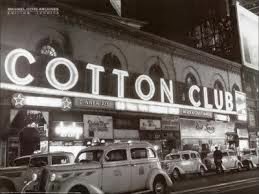
In 1927, the leader of the house band at the famous Cotton Club in Harlem died. Duke and his band got the job--they were already popular and had a following.
The Cotton Club in Harlem
This is when changes started coming fast for the band. They were no longer known as The Washingtonians, but as the Duke Ellington Band, and this caused some musicians' noses to go out-of-joint. Duke started adding hand-picked ultra-talented musicians until ultimately the seven-piece group grew into what became a traditional standard big band: five trumpets, five trombones, five saxophones with some doubling on clarinet, a rhythm section consisting of drums, guitar, and string bass, and Duke down in front on his signature white piano. With the bigger band and more demand for sheet music, Duke finally had to learn how to write more traditional jazz scores with parts (know as 'charts'). He was still using melodies and 'licks' from the musicians, only now sometimes he would pay them $25 for a good melody. This is how "Concerto for Cootie" was born: trumpeter Cootie Williams came up with a tune around which Duke wrote a song. It became "Concerto for Cootie" and eventually "Do Nothin' Till You Hear From Me" when words were added.


That's where we'll leave Duke Ellington and his Orchestra. They are very popular at the Cotton Club in Harlem and about to embark on national and then European tours. Black musicians did not have an easy time finding hotel rooms at this time. They got around this in their American tours by sleeping in their own customized Pullman cars attached to regularly-scheduled trains. Duke Ellington and white Irving Mills protected the band members from prejudice so well that they didn't know the extent of what existed unless they left the band. They were extremely popular, now as Duke Ellington and his Famous Orchestra, continuing to polish their style into the 1930s, '40s, '50s, '60s, and even the early 1970s. They never lost their original signature tunes, but rearranged them constantly and added newer techniques.

By the way, while they were touring but still considered the house band at the Cotton Club, another band led by a guy named Cab Calloway took over at the club. But that's the subject of a future Harlem Renaissance-themed post...